
Showing posts with label book review. Show all posts
Showing posts with label book review. Show all posts
Tuesday, December 2, 2025

Thursday, October 9, 2025

Saturday, September 20, 2025
Book Review of Erin O'Luanaigh's "Avail"
Erin O'Luanaigh, Avail (Paul Dry Books, 2026) poetry. Not yet released at the time of this review.
Erin O'Launaigh spent part of her childhood battling a clotting disorder and writes about it here sublimely. She uses the practice of veiling to express the de-bodying experience of no longer being allowed your own personal dignity and modesty, while at the same time no longer being seen as quite human that occurs as a patient. This collection is a beautifully astute window into the disabled person's world, written in a fresh, unheard voice. This should be required reading.
Favourite lines:
"with a love that, like all love,/ distorts its object// glazes it with ice,/ swallows it like a mailbox" - "Snow"
"And when I lived, I was embarrassed. I felt I'd let them down." - "A Childhood Illness"
"Nothing is less logical than the truth." - "The Awful Truth"
"to star in the movie of myself/ instead of playing second lead" - "The Awful Truth"
"the circulatory system is a veil our body has swallowed whole." - "Veins"
"the artist comes to see the world as a series of roads" - "Red Travels"
"To wear lipstick or to sweep blush on the apples of one's cheeks is to affect the appearance of blood. Pallor is a kind of frankness. A body drained of blood is a naked one." - "Blood as a veil"
Wednesday, June 25, 2025
Review of Kris Ringman's "Sail Skin"
Kris Ringman, Sail Skin (Handtype Press, 2022) 70 pages, poetry. More info here.
Kris Ringman has written a contemplative poetry collection that aches with the longing for connection. There are images of taxidermy, an affinity with animals (particularly of the canine family), a cross-section of cultures, a cannibalism fetish, and, most strongly, a series of poems about sailing and the sea.
As a disabled person myself, I decided to reach out to presses that focus on publishing the work of disabled poets as a reviewer. This book is part of that initiative. Ringman is a deaf poet and writes from that perspective. Among their poems are those which speak of the "outside" feeling of being deaf and the idea of foxes that sign: "hands/ in the air spell out their feelings" - "If Paws Were Hands". A sublime moment is this: "The only reason I wish I could hear/ is to learn how to open my mouth - / ... // I want to make you weep/ from just one word - " - "Mountain".
Other favourite lines are:
"I follow them/ without my body, only the wish to become." - "Can't I Just Be a Fox?"
"like the memories you carry of the men/ who have assaulted you?// So careful,/ how they slow down - " - "That Precarious Edge"
"The problem with having lived in several countries/ is everything follows you home." - "That Precarious Edge"
"Since when is the world a solid place to stand?" - "A Boat Carries You"
"Sometimes only the broken pieces/ are showing, but that doesn't mean/ the rest isn't whole." - "Fox Skin"
Tuesday, May 13, 2025
Book Review of Andrea L. Hackbarth's "waveforms: a short course in piano tuning"
Andrea L. Hackbarth, waveforms: a short course in piano tuning (Small Harbor Publishing, 2025) 37 pages, poetry. More info here.
This is hands down one of the best poetry collections I have read so far this year. Andrea L. Hackbarth tunes pianos as her day job and writes poetry as her passion. Here, they marry and have a child. This collection feels quite metapoetic in nature, using music as a metaphor for poetry. But is music a metaphor for poetry, or are music and poetry the exact same thing, using different instruments, Hackbarth's piano standing in for language? The boundaries blur, beautifully and divinely.
Favourite lines:
"They say it's possible to make of yourself a single song if you balance the force among your loves"
"Simply learn to use your tools as you press your ears into service."
"The possibility in a closed bud. The slow-moving glory-be of its opening"
"Spend hours in service of each singular note, then see if they hold."
"My mind has settled in the still of December, while my fingers tingle with recollections of summer wind."
"Generations of mothers and daughters echoing & echoing. Can you hear the long -forgotten matriarch?"
"Your task: to find where the whispers align among the notes"
"Listen: you may hear god's voice in the convergence"
"Who doesn't love an origin story? We repeat & repeat the one repeated to us and build our meager lives around it."
Tuesday, March 11, 2025
Review of Kalehua Kim's "Mele"
Kalehua Kim, Mele (Trio House Press, 2025) 100 pages, poetry, forthcoming on July 1, 2025. More info here.
Kalehua Kim explores themes of death, family dynamics, and the relationship between mother and daughter in this collection of songs as poetry. I was excited about this as an indigenous work. It seemed to have a lot of potential as a book that has many layers of possible understanding and prisms of viewpoints.
I was especially eager to learn some Hawaiian until I discovered that each time Hawaiian appears in the text, it is a repetition of an English phrase that has already occurred, making it merely decorative - a flower to signal that this is an indigenous poet - but serving no real depth of purpose in most cases. Identity as product placement?
My favourite parts of this collection are those that focus on the poet's personal memories of her mother: how she used to sing all the time, the songs they used to share, and the intimate moments by her deathbed. These moments carry the weight of depth and of real soul. This is where we feel closest to the emotional need that drives the poet to write in the first place and where the poetry feels the most original.
Favourite lines:
"I have lost all but one tale/ you told to me in childhood./ Days were longer then," - "Ka Hale, The Nurturing Place"
"You yearn for the days when your people died/ in the beds in which they were born." - "Dying Looks Like"
"we shared so/ many words/ all we didn't say/ full" - "Glottal Stop: My Mother's Last Words"
"Other mothers find me here://... they all come to me, mothers mothering me/ Mothering with a silence that is not her silence." - "Not One Parking Space"
"His silence, humid and thick as thunder,/ hangs heavier than the sun-sapped mangoes" - "Memory Sonnet"
"No cloth can keep you clean" - "Woman's Work"
"My belly ready to spill its light// ... I pushed until I broke open with light." - "Makalii and the Stars That Followed"
"the only way to look at time is to refuse to see time" - "Ha"
"The weight of fruit strengthens/ the branch eventually." - "Songs for the Life I Chose or How to Stay Together"
Wednesday, March 5, 2025
Review of Han VanderHart's "Larks"
Han VanderHart, Larks (Ohio State University Press, 2025) 86 pages, poetry, forthcoming at the time of this writing. More info here.
There's a lot going in this collection in a comparatively brief space. VanderHart covers subjects as variable as sibling-on-sibling child sexual abuse, mental illness, generationally changing values on parenting, a love of nature and herbalism and birds, a deep sense of place, etc. All written in a familiar Appalachian voice (but not the Appalachian language. Not to worry, if you are from elsewhere, this is written in standard American English but the Appalachian voice very much comes through). A lot of the poem titles are quotes, revealing that VanderHart has understood the assignment of every good writer: they read more than they write.
They hook you in with some comfortable poems that root you in place without explicitly naming that place. And then they land the punches of the real battles this book tip-toes around. I say "tip-toes", because as hard-hitting as some of this is, there is always the feeling that VanderHart is holding back, swallowing the worst, because they know it's too much for us. I respect that.
Favourite lines:
"I do not know whether it is morning or mourning" - "Invocation"
"My mother's family dammed the river and trapped the fish so often/ it became their name." - "The Body Is Water and the Water Has Origins"
"I think you should use the language/ of where you come from" - "Artist's Statement In a Mountain Cabin"
"Some things you fix/ and they break again/ and again" - "Broken"
"I measure your beginning by a glass of water and the hands that/ caught you. Somewhere" - "How people tell time is an intimate and local fact about them" Ann Carson
"... what's inside the heart and also/ the land: the dirt containing more" - "Virginia seemed like always right" David Lynch
"I Can't Let My Mind Go to the Thicket" - whole poem
"I want an otherworldly ex-/ planation for unkindness, which // is the milk of the world." - "Larks"
Ohio University State Press is a BIPOC/LGBTQIA+ Press.
Saturday, February 8, 2025
Review of Kiarah Hamilton's "this is what fifteen feels like"
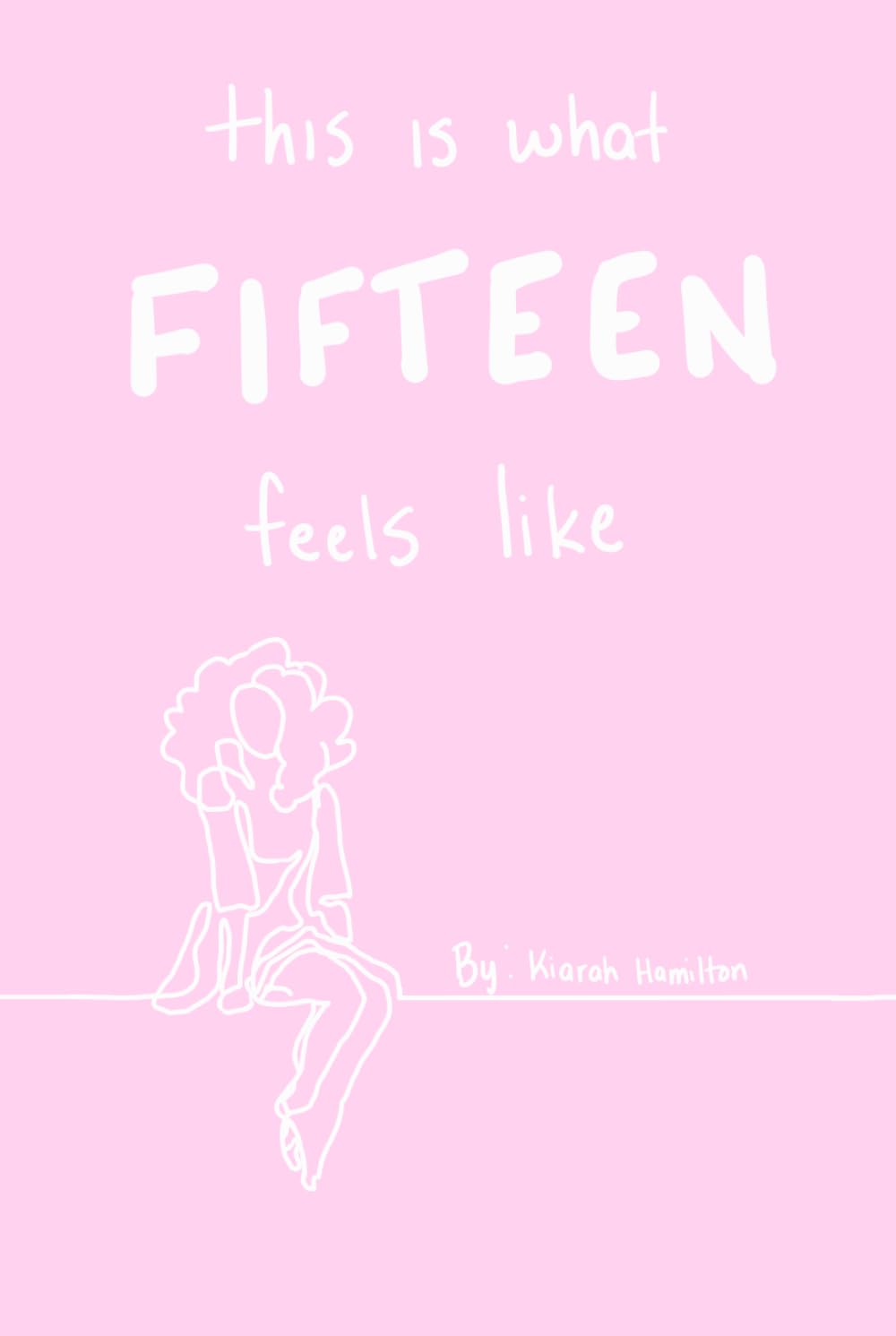
Kiarah Hamilton, this is what fifteen feels like (KDP, 2024) 145 pages, poetry, $19.99 US. Order here.
Hamilton invites us to read this collection from the point of view of our 15-year-old selves so that's where I'm going to write this review from (mostly). I say "mostly" because I'm late Gen X and Hamilton is Gen Alpha, I believe, so our 15s are very different POVs. When I was 15, the internet was called "Prodigy", it was dial-up, extremely expensive, almost no one had it (almost no one had a PC), and social media didn't exist yet. Late Gen X are in general a nihilist group of people who believed the world would end before they finished college and as teenagers were criminals and gangsters who got away with everything precisely because they were the first generation with parents who divorced at high rates, worked two jobs, daycare didn't exist yet, and smartphones were sci-fi. It was ghetto. I'm sure it's extremely difficult for kids today too, just in very different ways. Same old threats with new avenues.
As a teenager, I was a moody goth but not goth, punk but not punk, (nowadays the term might be "emo") loner who wrote poetry and lurked in shadows and wore black as often as my mother would let me get away with it. Because if you wear black and stand very still, you can be as near to invisible as physics allows. Very handy for avoiding bullies. My poetry was similar to Hamilton's but much less innocent and light. I wrote about dark stuff. I wrote about stuff I lived with, violence and loneliness and darkness. And I found beauty in it. And, stereotypically for a teenage poet of my generation, I could quote Edgar Allan Poe's "The Raven" on cue (I can't anymore). None of my early poetry survives today.
Hamilton writes more as a teenager should, if there is such a thing. Her poetry is as light, innocent, and clean as her book cover. It's refreshing. She writes about the pressures social media puts on youth to have a certain appearance, which is something that certainly hasn't changed, although social media has prismed it uniquely. She writes about social anxiety, the stresses that hormonal changes bring, trying out different hobbies to find a few that'll stick as she works out who she is, and her crushes. All typical of the adolescent experience. And which certainly do help take you back to your own personal experiences.
There are some poems here that give you a window into Hamilton herself. She writes about moving around a lot and about her family dynamics. Another fun feature is that she includes a playlist of songs that you can look up on Spotify or YouTube. This places her 15 in a specific time frame - more so than the copyright notice will because not everyone reads a title page - but it also includes a whole other dimension to the book and a view into the poet's mind. I particularly liked this because when I write, I always have soundtracks in mind too. But since it never occurred to me that I could simply write up a playlist to include, I weave the songs into the poems and books themselves in ways I'm sure no one has caught on to, lol. Hamilton's playlist is an elegant solution to this conundrum.
In summary, this is what 15 feels like. The poetry is not sophisticated. That's not what you're here for. But it is what you're here for. A walk down memory lane vicariously. A reminder that no matter how many years have passed, 15 is never very far away.
Thursday, January 2, 2025
Review of Stephen Spanoudis' "Final Orbit: Not All Ghosts Are Human: The Autobiography of Mario Ng (The Republic of Dreams)"

Stephen Spanoudis, Final Orbit: Not All Ghosts Are Human: The Autobiography of Mario Ng (The Republic of Dreams) (The Other Pages.org, 2021) 215 pages, fiction, $9.99 US. Order here.
I am a poet and I read mostly poetry and nonfiction. In 2023, I decided to read more fiction. I want to learn how to write better prose to write the stories my grandparents wanted me to write. Better late after their deaths than never. And there is no better way to learn how to write than to read. And it seems the world is conspiring to help make that happen: I always wanted to join a book club and that happened in 2024. What is the group interested in reading? Fiction. And in 2023, Stephen Spanoudis gifted me (out of the blue) two of his novels.
Both these novels are part of a series. Final Orbit is the 8th book but is written as a prequel to the others. This review will focus on Final Orbit. A review of the second book is forthcoming.
Final Orbit took a while to get off the ground (pun intended). You had these two incredibly determined and intelligent people overcoming underprivileged backgrounds to succeed in challenging careers (astronaut and musician, respectively). They have fulfilling lives. Everything seems to be winding down to a kind of calmer precursor to retirement and I'm wondering "but am I only halfway through the book?" And then BOOM (literally), the real story kicks off. And takes your breath away, rips your heart out, and leaves you gasping and needing to take a walk around the room a few times. You're going to need to take a minute. That's just the first drop of this roller coaster.
This book is equal parts future dystopia, science fiction, drama, romance, psychological study, and inspirational fiction, with a bone thrown to the Harry Potter in the briefest way possible, and for once the U.S. is a side character in major "historical" events. It's popular today to categorize fiction as narrowly as possible for social media tags. But it's difficult to categorize this in any way more niche than simply "fiction" because it fits so many tags at once.
I'm tempted to say there could be maybe a little too much happening here. It's a lot to process emotionally and mentally for an average reader. It's definitely written for an intelligent, quick-thinking type who will be mindful to shepherd themselves kindly through the emotional ups and downs. But there are valuable nuggets of wisdom one can carry forward into the real world as well.
Tuesday, November 19, 2024
Review of Douglas Cole's "The Cabin at the End of the World"

Douglas Cole, The Cabin at the End of the World (Unsolicited Press, 2024) 98 pages, poetry, $16.95 US. Order here.
This reads like a pandemic book. It is full of frenetic energy as if we are inside the head of a shut-in with cabin fever. It starts out as a collection of prose poems rooted in locations. We bounce around the U.S. with a series of snapshot-like moments and roll-call listings of street names. And lines like these:
"I wash my face. I make food. I look out a window. Time is very slow. Winter extends itself. I lift weights, think or read. Spring is under glass. And if you read much further, you become part of the fable." - "Distances"
As the book evolves, however, the energy calms, the poems change form, and you are introduced to the title cabin and the (increasingly more content) human who inhabits it. Therefore, this book represents a journey. At first, it seems quite external perhaps. But it becomes clear that the journey is an internal one of someone learning to enjoy a measure of solitude in a "cabin at the end of the world".
Lines that stood out:
"he has to say stone and stone again" - "Drive Through"
"Darkness swallows the city down to its diamond feet and snakeskin streets" - "Infinite Gaze"
"a drone-dead sky blasted open with no parachute to cling to" - "Notes for The Grey Man"
"Like an abandoned theatre, as I wander through the empty rooms because there's no one else here. Time is happening without me." - "Caught in a Dream"
"water can tell how it took down mountains to liberate you" - "West Cove"
Disclosure: I did receive a free review ebook copy to read in order to write this review, as is industry standard.
Kevin Kiely Reviews "Faller"

"Faller" by
Sabne Raznik
These fictional poems from Raznik come with a ‘trigger warning’ 20 years after the 9/11 Twin Towers Tragedy in New York. The Photo of “The Falling Man” is referenced along with those of the others who died. Raznik says ‘I borrowed a word from the sport of steeplechasing, one that I feel is more accurate, fully inclusive, and carries no stigma: Fallers.’
Her hyper-delicate, hyper-sensitized material is red flagged thus: ‘Nor is it meant to cause pain to anyone who lost loved ones that day. Nor is it meant to trigger anyone who battles depression and suicidal ideation’ […] ‘this book is a personal psychological purging.’
Impossible to not engage in some give-away of content within FALLER by sampling lines at random. There is anonymity held to, in that those who are among the Faller(s) and falling 'are' in flights of time, speed, rapidity and fleeting reality which makes this a fast-forward plunge with the words, it cannot but be: language falling into or onto where?
This depends on your own personal reading as to what place, space or time you arrive 'within' reaching the last line. Here are clusters of word-scape that fell out as this review aspect-wheeled through the lines of Sabne Raznik in FALLER.
The urgent poems are stark as in:
‘I remember reading in school about
The Triangle Shirtwaist Factory Fire,
How some jumped to their death
Rather than burn since there was
No way out.’
‘When I land, they’ll be precious little left
More than an imprint in the sidewalk.
Hope I don’t hit anyone below…’
‘Like we were standing inside the sun.
So much paper around me, like snow.
I am snow now.’
‘Do you remember, little brother, how we use to
Drop water balloons off the fire escape?
Count how long they took to fall?
How we tried to film impact and slow down the tape?
Our science projects?
It’s like that.’
Raznik has also released a collection of artworks Renaissance: Visual Art 2005 - 2019. She founded and co-edits AvantAppal(achia) ezine and believes herself to be a supranational poet, in that she feels the arts transcend manmade boundaries.
- Review of Sabne Raznik FALLER. © Kevin Kiely., Poet, Critic, Author; PhD (UCD) in the Patronage of Poetry at the Edward Woodberry Poetry Room, Harvard University; W. J. Fulbright Scholar in Poetry, Washington (DC); M. Phil., in Poetry, Trinity College (Dublin); Hon. Fellow in Writing., University of Iowa; Patrick Kavanagh Fellowship Award in Poetry; Bisto Award Winner.
Recent Publications include: ‘Stratford-upon-Shakespeare and other Lies’ AND 'The Principles of Poetry DI + ID = Ѱ Psi' Books available on AMAZON.
Saturday, September 28, 2024
Review of the book "Hortensia: in winter" by Megan Merchant
Megan Merchant, Hortensia, in winter (New American Press, 2024) 66 pages, poetry, not released yet at the time of this review. Preorder info here.
Hortensia: another name for the hydrangea flower. It's also the poet's ancestor who was a follower of Joseph Smith. After Smith's death, and when that Church accepted polygamy, Hortensia broke with Brigham Young and followed Joseph Smith's widow. That belief system ended with Hortensia, it seems. Merchant is a non-practicing Catholic. In this collection, Merchant explores the connection of generations through time.
In profound, lilting lines that feel as though they ought to appear on glossy photo paper surrounded by peonies - cozy like a coffee shop but trendy like an interior design magazine - Merchant seeks to tie the mundane motions of her everyday life back to Hortensia to empathize with her. How do the tiny details of living repeat across generations? How can ancestors we never knew bring comfort when we learn significant news? Merchant asks these questions of Hortensia. Although the book is composed of prose-poem meditations that are mostly inward-focused, the overall effect feels like an attempted conversation. Where Hortensia fails to speak in return, the poems tend to read as letters to Hortensia, rather than as mere thoughts.
This is one of the best collections of poetry I've read this year.
Lines that stood out:
"I want to ask the hard questions, but they sharpen back to god." - "Invocation"
"Were you given the smallest room in the house of your own life? I am gifted a single window." - "Helpmeet"
"A woman's work, I was taught, was to endure. ... A woman must remain pure." - "Applying to Sainthood"
"Now no daughter will seed. I will be scraped clean." - "Merciful"
"I am learning the landscape of my lineage now... I'd like to find more than a name to hang in the rearview mirror." - "Picking Wild Berries"
"What notes still play in my blood? What warnings?" - "Score"
"I take your silence as permission to continue." - "Famine"
"Hymn" - the whole poem
"To sink into the earth is a gift ... a kind of holiness ruptured." - "Have You Branded an Animal that You Did Not Know to Be Your Own?"
"Salvation" - the whole poem
"This year I am hungered down to bones." - "How to Describe Winter"
"Regret is a scratch of light between trees." - "Watching the Praire Fires as Pastime"
"The abyss I feel in my bones." - "Portraiture: Dark Room, Self in the Mirror"
"My interior is unchurched. ... the way the wind is tongue-tied at the mountain base." - "Love"
"The testimony of wreckage, beautiful." - "Harmonies"
"The only thing that matters is what comes after the last word." - "Invocation" and "Revision"
Disclosure notice: I received an Advance Review Copy of the book to read and write this review. No money was exchanged.
Monday, May 27, 2024
Review of "Word Troubadours" by PJ Swift and Ellyn Maybe

PJ Swift and Ellyn Maybe, Word Troubadours (2024) 32 pages, poetry, $10.00 PDF; $15.00 Physical book. Order here.
Ellyn Maybe is a spoken word artist I first came across when she was in the Los Angeles area about 15 years ago working in a creative group centered more or less around Beyond Baroque that included the likes of Yvonne de la Vega, Ray Manzarek (formerly of the Doors), and Michael C. Ford who took Beat concepts, wrapped them in a confessional flare with a punk rock graffiti edge, and rapped them - sometimes whimsically, sometimes cooly, sometimes sing-songy - over jazzy soundtracks. This is the first of her works I have encountered as a purely on-the-page experience. This is also a collaboration with PJ Swift.
This creation is titled Word Troubadours and music is therefore an important theme throughout. Music, singing, performing, visual art - this collection is the space where poetry intersects with most other forms of artistic expression. PJ Swift presents the metaphor of poem as a Rave and Ellyn suggests that life is a Musical. I personally would argue against both concepts as being either misconceived or over-romanticised, but each to his/her own. Still, that gives you an idea of the highly unconventional, almost dreamscape of these poems. And I'm always excited by hyper-imagined, nonconventional mentalscapes in poetry.
Ellyn Maybe includes a kind of personal Odyssey with "Ellyn Maybe's Dream" where she travels to Prague - whether only in dream or also in waking life, I'm not sure - and has a transformative experience that involves a gargoyle.
Some phrases I wrote down that stand out:
"We resist the temptation to crawl into the world/ and pull our psyches over our heads./... We need our exuberance more than our math." - "Cinema Dance" - Ellyn Maybe
"I know how men make women wear armor of all kinds" - "I Heard What Sounded Like A Song", Ellyn Maybe
"Perhaps life is like a multiple choice question my friend/ The answer's in a circle dance with no beginning or end." - "Somewhere in the Sky", Ellyn Maybe
"an era whose burdens/ have granted no choice" - "Creation of Myths" - PJ Swift
"avalanche in the bones of the land" - "Train", Ellyn Maybe
May these Word Troubadours keep on soothing our souls with their songs and stories of our time for the ages to come.
Friday, April 12, 2024
Review of "Fill Me With Birds" by Scott Ferry and Daniel McGinn

Scott
Ferry and Daniel McGinn, Fill Me With Birds (Meat for Tea
Press, 2024) 104 pages, poetry, $16.95. Order here.
Those
nights when you stay up past midnight and the conversations go silly and then
profoundly deep, that's what this is.
Two
mature men muse on everything from aging parents to children, to marriage, to
health issues, to overcoming addiction, to God, to the changing of seasons, to
resentment and forgiveness. The poems are written as if letters or emails going
back and forth. But in my head cannon, they are sitting in a late-night living
room in front of a fire passing a (legal) smoke between them.
At
times, it can feel almost too intimate and honest for the reader to eavesdrop
on politely. This is good stuff.
Most of
the lines I made note of were Scott Ferry's, I think, though I didn't track who
wrote which line. If you want to know that, you can read it. But here are some
of the lines that stood out to me:
"I
know now it is too late for/ bargaining// the best I can manage/ is
obsolescence"
"the
face of god: is the inside of longing when there is no waiting left"
"Nerves
are like brains,/ remember how we used to be? The body knows/ what is and isn't
there."
"I
lost the easy talk/ I did not want to impress anyone anymore"
"solve/
hate like a controlled burn/ near a freeway"
"I
still have a fire a fire a fire"
On
meditation, some of these poems are darker and heavier than they appear. The
request to "fill me with birds" seems to be a wish for a lightening
of the soul from the burdens voiced through these conversations.
Wednesday, February 7, 2024
Review of David B. Prather's "Shouting at an Empty House"

David B. Prather, Shouting at an Empty House (Sheila-na-Gig Editions, 2023) 96 pages, poetry, $16.00. Order here.
David B. Prather is an accomplished Appalachian poet from Parkersburg, WV. This collection started reasonably well. It has some familiar and comfortable themes and images.
But it wasn't long before I realised my mind had largely disengaged. These poems are too familiar and comfortable. They have that expected MFA/Workshopped/I've-read-this-all-before-a-million-times feel. They also leave no room for the imagination. There is nothing left unsaid for the reader to interact with. And some stereotypical plays of manufactured empathy are clearly meant to elicit gasps of awe from the audience at a poetry reading without having any real emotional depth.
Therefore, when the occasional sparkling phrase manages to stand out from the page, it isn't enough to carry the entire collection.
If the current fashion of MFA/Workshop-approved poetry is your thing, this is your book. It is exactly everything that has been published in the last 20 years. Prather's author's bio reflects that. Call it PopPoetry. Clearly, a lot of people do appreciate it; particularly the people who decide what gets printed.
Personally, I'm bored with it.
Wednesday, November 1, 2023
Book Review of Sacha Archer's "Cellsea"

This is a book of avant-garde poetry that is the genre "vispo": visual poetry. This is where poetry and visual art become one. It's a fascinating genre.
But how to write a review on it? That is the challenge I agreed to take on.
Sacha Archer and Timglaset Editions give us a fun, quirky little book with two covers. It can be read in two different directions, in colour and in black and white. Just like the ocean, it swirls and ebbs and pulses and envelopes and washes us around. And we get to play in its mysterious depths and moods and turns. And there is plenty of room for personal interpretation. The idea seems to be that as we swim about in the immense sea, we also swim inward into the single cell of our origin.
And since this is vispo, I thought the best way to go about about this would be include a few images of the poems inside. It was difficult to get good quality, shadowless images in my living room, but here is a very small sampling of the suprising, fun profundity of this volume:


This is one book I am proud to add to my personal library.
Tuesday, August 1, 2023
Review of john compton's "blacked out borderline from an exponential crisis"

john compton, blacked out borderline from an exponential crisis (Ethel Press, 2023) 54 pages, poetry, limited run of 60 copies, $10.00. Order here.
On the whole, I'm a big fan of john compton's poetry, having read most of his oeuvre to date. There is something delightful and irresistible in the music of his phrases and the dagger-focus evident in each individual word. Each poem is crisp against the teeth and tart on the tongue like a green apple with a whisky after-bite in the throat. These aren't the kind of poems to cuddle up with in the winter with a cup of tea and a blanket. They do not comfort; they jar and jostle. Not as extreme as a rollercoaster. More like slight turbulence in a cross-country flight. And they are deeply autobiographical, like confessional poetry modernised. As compton here says, a kind of manifesto of his poetry as I have experienced it so far: "my house is a/documentary untelevised unwritten/a secret it grows ...the empty only a symptom."
compton's work is not the place to go if you are a woman seeking refuge from the male preoccupation with penises and sex. He is proudly gay and many of the poems go there explicitly. Since I am not interested in sex no matter who is doing it, at least not explicitly, I tend to skip those. You won't find a lot of it in my own work, to be sure, unless you are determined or it is in the context of abuse. It simply isn't a big presence in my mental life.
There are blocks of poems here about compton losing several beloved dogs and puppies to a Parvo outbreak. These aren't sentimental in the traditional sense, however. More like love poetry with a lot of blood. And some of them can be read as metaphors for the experience of living through the COVID pandemic, and now learning to live with it as a constant background threat. He writes: "our aggression eats us." There is also a block of poems written about and to several historic poets, each one a projection of compton onto that poet in ways that are insightful.
Lest we should forget that he is, in fact, an Appalachian poet, he reminds us with his closing poem, which is a vague reminder of the ballad "Barbara Allen".
For me, the best poem in this particular collection is an ode to womanhood that has wizened and I will close this review with it:
she pauses in wading the lake waist
high the water touching parts she
forgot had existed she slips her
hand into the murkiness wondering
if her hair ever felt like this she
knew she used to be beautiful
before age broke her body across
the floor like a chair she rocks
herself her feet moving between
the silt the ducks revolve around
her like moons before settling in
their landing they search her she
understands she is not a tree but
could she just raise her arms like
branches & feel love for a moment
a foot farther an inch deeper she
remembers how to heal a wound
with a band aid before the children
were too old to not need her she
breathes she breathes she breathes
while everyone else has finished
letting her exist
Friday, November 11, 2022
Review of Scott Ferry's "The Long Blade of Days Ahead"

Scott Ferry, The Long Blade of Days Ahead (Impspired, 2022) 122 pages, poetry, $9.99.
This collection comes from those emotions or states of being we tend to struggle with integrating into our experience as humans.
It starts with anxiety. Poems like "4/26":
"so I better just be ok
be ok be ok I better just be"
set the tone. But it soon becomes apparent that the anxiety likely stems from grief. Many are the poems exploring Ferry's journey with learning to accept and move forward with the death of his father as a father himself.
"4/1"
i miss my father most
when my son screams
daddy and runs to me
with so many years
in his hands
The natural human tendency to confusion in the face of these overwhelming emotions is seen here too. Ferry mocks and belittles faith. At the same time, he often speaks of ghosts and hauntings, believing that his father is visiting him in his afterlife state. Yet he seems not to be aware of the contradiction inherent in holding both these viewpoints at the same time. All of this holds true to the illogical emotional noise that accompanies grief and anxiety.
And it all makes for some intriguing poetic moments. Overall, this is a collection worth buying and reading.
Monday, October 10, 2022
Book Review: "Why We Argue and How to Stop" by Jerry Manney

Jerry Manney, Why We Argue and How to Stop: A Therapist’s Guide to Navigating Disagreements, Managing Emotions, and Creating Healthier Relationships (TCK Publishing, 2022) 175 pages, self-help, $19.99. At Amazon. https://jerrymanney.com/
I'm not thrilled with self-help books, to be honest. Generally, they are too quickly read and forgotten. The real benefit comes from application - and that rarely happens without the buddy system, someone to gently hold you to account and enthusiastically encourage you along the way. This is why working with a professional therapist has a much better success ratio than reading some random book.
This particular book, however, is different. This one is interactive. It is set up like a workbook. Get your pens and pencils out and write in it, please. Get interactive. Get involved. Journal. Take notes. Be specific. This one encourages you to actually apply the suggestions it makes to real scenarios in your life. In real time. In a realistic way.
Would you still do better with the buddy system? Absolutely. But this is a solid place to start. This is a self-help book that is actually designed to help. If you do get your pens and pencils out and do the exercises, you'll be less likely to just trash this book in a week. You might even remember a few of the suggestions when emotions are peaked. And that's about as high a bar as a self-help book can reach. Bravo.
Wednesday, June 1, 2022
Review: "Drinking Guinness With The Dead" by Justin Hamm

Justin Hamm, Drinking Guinness With The Dead (Spartan Press, 2022) 163 pages, poetry, $15.00. At Amazon.
Justin Hamm presents us with a selection of his poems from 2007 through 2021 in this amusingly titled volume. While Hamm is strongly based in the American mid-west (he lives in Mark Twain territory), he proves himself to be a strong poet of place wherever he is writing from. Even poems that address relationships and inner child work are firmly grounded in earth and to specific locations.
"The air in this place/ is ripe/ with some kind/ of weather."- from "Ohio County, Kentucky, 1985".
"They come from the mountain, he says,/ Their faces cold as the moon's." from "Stranger at the Only Fueling Station in Kingston, Arkansas".
"a night train torches/ through the dark stomach/ of the prairie" from "A Moment in Kansas"
Hamm is a man walking the planet and keenly aware of roots, of ground, of river, of tree-sway, of time, of turning-turning-turning in outerspace at all times. He never loses sight of it. He has a connectedness to all the moving machinery of nature and reminds us that it is machinery. He raises a toast to it - to history, to place, to time, to people past and present - and passes us the pint.
Subscribe to:
Posts (Atom)